High-performance acoustic systems require correct material selection and disciplined installation.
We provide supply and installation of engineered acoustic materials for architectural and industrial applications across Saudi Arabia, ensuring performance matches design intent.
Our scope integrates:
Verified acoustic performance data
Build-up specific detailing
Coordinated shop drawings
QA/QC controlled installation
Site testing alignment
Services available in:
Riyadh
Jeddah
Dammam
Makkah
Madinah
Architectural Acoustic Systems
Architectural acoustic materials must achieve both performance and visual integration.
We supply and install systems designed for:
Offices
Hospitals
Schools
Mosques
Residential towers
Government buildings
Wall & Ceiling Acoustic Panels
Fabric-wrapped acoustic panels
PET acoustic panels
Timber slat absorptive systems
Micro-perforated wooden panels
Perforated gypsum and metal ceilings
Performance range:
NRC 0.65–1.00 depending on system
Mid-to-high frequency absorption control
RT60 optimisation
Installation scope includes:
Subframe alignment
Joint sealing and edge detailing
Integration with lighting and HVAC
Access panel coordination
Acoustic Partitions & Insulated Assemblies
High-STC gypsum systems
Double-stud and decoupled partitions
MLV composite build-ups
Shaft wall acoustic systems
Performance range:
STC / Rw 45–65 depending on assembly
Installation controls:
Deflection head detailing
Electrical box isolation
Penetration sealing
Flanking mitigation
Acoustic Doors & Glazing
STC-rated acoustic doors
Drop-down seal systems
Compression perimeter seals
Laminated acoustic glazing systems
Critical detailing includes:
Frame anchoring
Threshold treatment
Seal continuity
Airtight perimeter sealing
Impact Isolation Systems
ΔLw underlay materials
High-density resilient layers
Gym floor isolation systems
Floating screed assemblies
Installation considerations:
Edge isolation strips
Vertical flanking control
Compressive strength compatibility
Floor finish coordination
Industrial & MEP Acoustic Systems
Industrial acoustic materials must withstand mechanical load, moisture, and vibration while delivering measurable attenuation.
We supply and install systems for:
Mechanical rooms
Plant rooms
Generator enclosures
Industrial facilities
Chiller yards
Acoustic Cladding Systems
Steel acoustic sandwich panels
Metal-clad absorber modules
Composite barrier-absorber systems
Performance:
20–35 dB(A) reduction depending on configuration
Broadband attenuation from 125 Hz – 4 kHz
Installation scope:
Structural fixing design
Sealed perimeter detailing
Access panel integration
Fire-rated coordination
HVAC Silencers & Louvers
Rectangular and circular silencers
Elbow and cross-talk attenuators
Acoustic ventilation louvers
Performance:
Insertion Loss 10–40 dB depending on design
Pressure drop controlled
Installation controls:
Velocity compliance
Support coordination
Airtight duct connections
Integration with dampers and fire systems
Acoustic Enclosures
Generator acoustic enclosures
Pump and compressor enclosures
Modular industrial housings
Performance:
25–45 dB(A) noise reduction depending on build-up
Installation includes:
Panel assembly and sealing
Ventilation attenuation integration
Cable and pipe penetration control
Vibration isolation interface
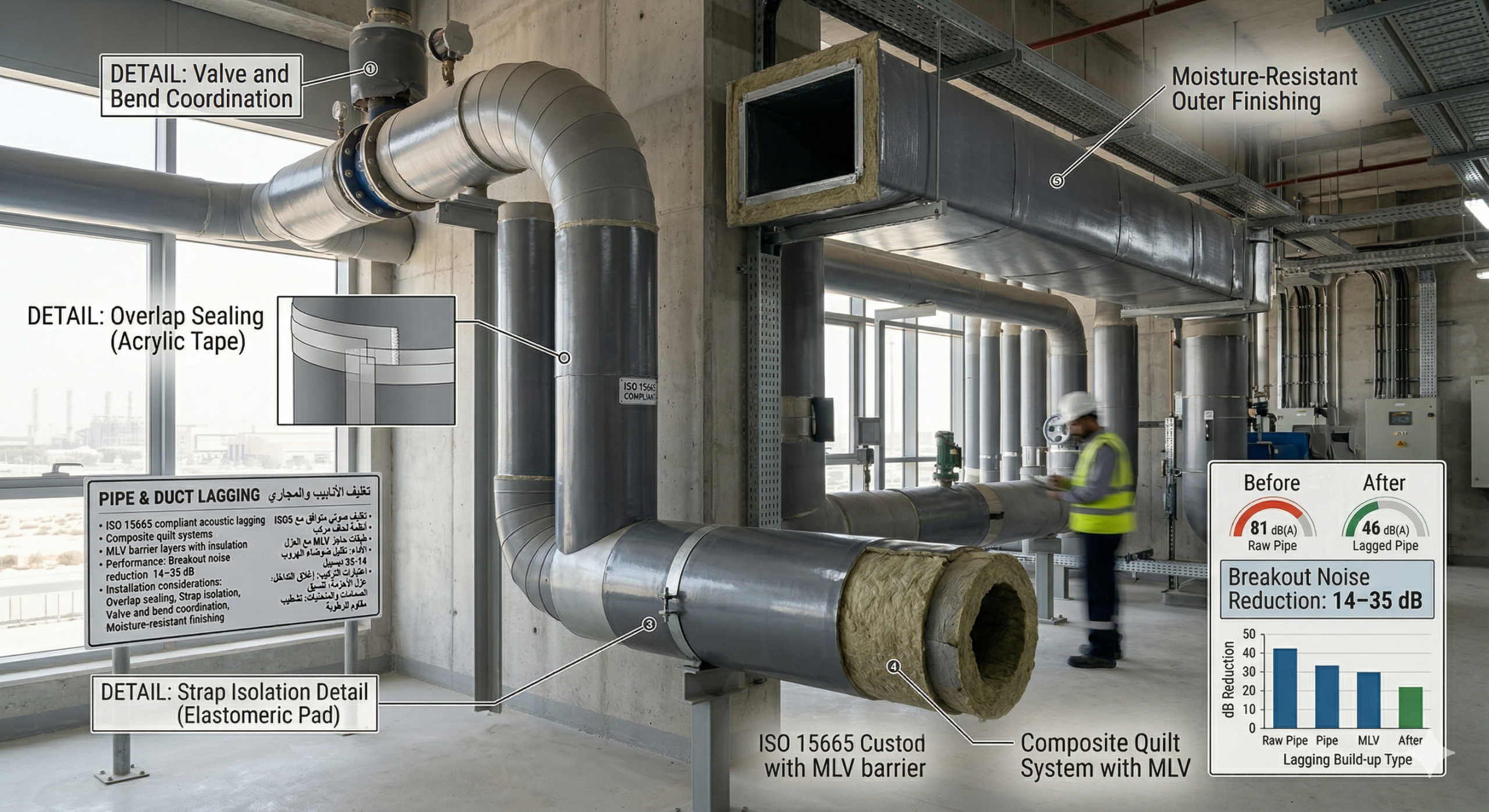
Pipe & Duct Lagging
ISO 15665 compliant acoustic lagging
Composite quilt systems
MLV barrier layers with insulation
Performance:
Breakout noise reduction 14–35 dB
Installation considerations:
Overlap sealing
Strap isolation
Valve and bend coordination
Moisture-resistant finishing
Quality & Compliance
All supplied and installed systems align with:
Saudi Building Code
ISO acoustic standards
ASHRAE guidelines
Project performance specifications
Where required, we support:
ISO 16283 testing
Reverberation verification
NC measurement
Boundary noise validation
Acoustic material performance depends on installation accuracy.
Supply alone does not guarantee compliance.
Proper engineering and execution ensure predictable results.