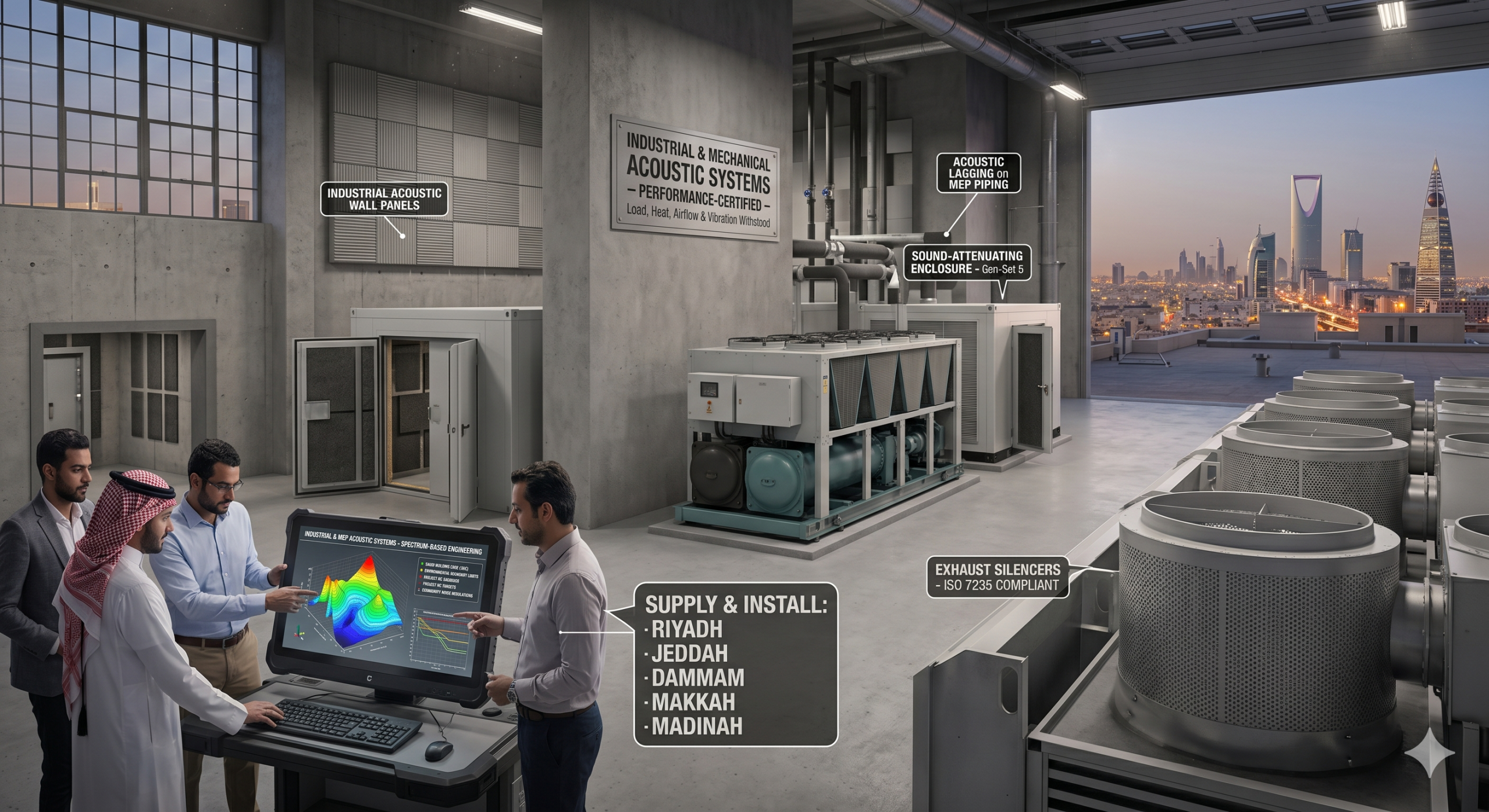
Industrial and mechanical acoustic systems must withstand load, heat, airflow pressure, and vibration while delivering measurable attenuation.
In Saudi Arabia, plant rooms, generator yards, cooling towers, and industrial facilities require engineered acoustic control to meet:
Saudi Building Code
Environmental boundary limits
Project NC targets
Community noise regulations
We supply and install performance-certified industrial acoustic systems in Riyadh, Jeddah, Dammam, Makkah, and Madinah, designed through spectrum-based engineering.
Acoustic Cladding & Wall Lining Systems
Used in:
Plant rooms
Generator rooms
Mechanical service areas
Industrial workshops
Material Composition
Perforated GI / powder-coated steel facing (0.7–1.2 mm)
High-density mineral wool core (48–96 kg/m³)
Optional MLV barrier layer
Backing steel sheet or vapour barrier
Galvanized structural support framing
Typical Thickness
50 mm
75 mm
100 mm (enhanced low-frequency control)
Acoustic Performance
Build-Up Thickness
Typical NRC
Transmission Reduction
50 mm absorber
0.70 – 0.85
15–20 dB(A)
75 mm absorber
0.85 – 0.95
20–28 dB(A)
100 mm composite
0.95+
25–35 dB(A)
Applications:
Pump rooms in residential towers
FAHU rooms below occupied areas
Industrial machinery rooms
Cooling plant enclosures
Installation includes:
Vibration-isolated framing
Full perimeter sealing
Penetration acoustic treatment
Access hatch detailing
HVAC Silencers & Attenuators
Mechanical airflow systems are major noise transmission paths.
We supply and install:
Rectangular splitters
Circular silencers
Elbow attenuators
Cross-talk silencers
Acoustic plenum boxes
Construction
GI or aluminum casing
Acoustic splitter baffles
High-density glass wool / mineral wool core
Aerodynamic nose profile
Perforated internal lining
Performance
Silencer Type
Insertion Loss Range
Typical Application
Standard Rectangular
10–25 dB
AHU discharge
High-Performance
20–40 dB
Generator ventilation
Cross-Talk
15–30 dB
Office partitions
Elbow Type
10–20 dB
Tight duct routing
Engineering checks:
Velocity compliance
Regenerated noise control
Pressure drop verification
ISO 7235 alignment
Applications:
Mechanical rooms
Hospitals
Office towers
Residential HVAC risers
Acoustic Louvers
Ventilation openings must attenuate noise without restricting airflow.
Construction
Weather-resistant aluminum / steel frame
Acoustic infill media
Multi-stage baffle configuration
Drainage channels
Typical Performance
Depth
Attenuation Range
Application
150 mm
6–10 dB
Light mechanical areas
300 mm
10–20 dB
Generator rooms
450 mm+
20–30 dB
High-noise environments
Key considerations:
Free area ratio
Wind load compliance
Water ingress protection
Structural fixing
Applications:
Generator intake/exhaust
Cooling tower yards
Chiller plant ventilation
Industrial exhaust openings
Acoustic Enclosures
Used for high-noise equipment where full containment is required.
Applications:
Generators
Compressors
Industrial pumps
Cooling towers
VRF condenser clusters
Construction
Steel panel modular system
Barrier + absorber composite build-up
Sealed door access
Ventilation attenuated openings
Internal anti-vibration base
Performance
Build-Up
Typical Reduction
Standard enclosure
25–35 dB(A)
Enhanced composite
35–45 dB(A)
Engineering integration:
Engine exhaust silencer coordination
Cooling airflow management
Vibration isolation mounting
Boundary noise modelling
Pipe & Duct Acoustic Lagging
Used to reduce breakout noise and structure-borne vibration.
Material Composition
Mineral wool insulation layer
Mass Loaded Vinyl (MLV) barrier
Aluminum / GI outer cladding
Stainless steel banding
Performance
System Type
Breakout Reduction
Basic Lagging
10–18 dB
Composite Barrier Lagging
18–30 dB
ISO 15665 Type A/B
20–35 dB
Applications:
CHW pipes
Steam lines
Large rectangular ducts Generator exhaust pipes
Installation details:
Full overlap sealing
Isolated support brackets
Valve and flange treatment
Moisture protection finishing
Vibration-Isolated Equipment Bases
For heavy mechanical equipment.
We install:
Spring-mounted inertia bases
Neoprene pad systems
Floating machine plinths
Anti-vibration hanger systems
Design targets:
fn 3–10 Hz
Static deflection matched to load
Transmissibility below 10–15%
Applications:
CHW pumps
FAHUs
Cooling towers
Industrial fans
Generators
Compliance & Verification
All industrial acoustic systems are aligned with:
Saudi Building Code
ISO 1996 environmental criteria
ISO 7235 silencer standards
ISO 16283 field validation
ASHRAE noise guidelines
Where required, we support:
Post-installation noise measurement
Boundary compliance verification
NC level confirmation
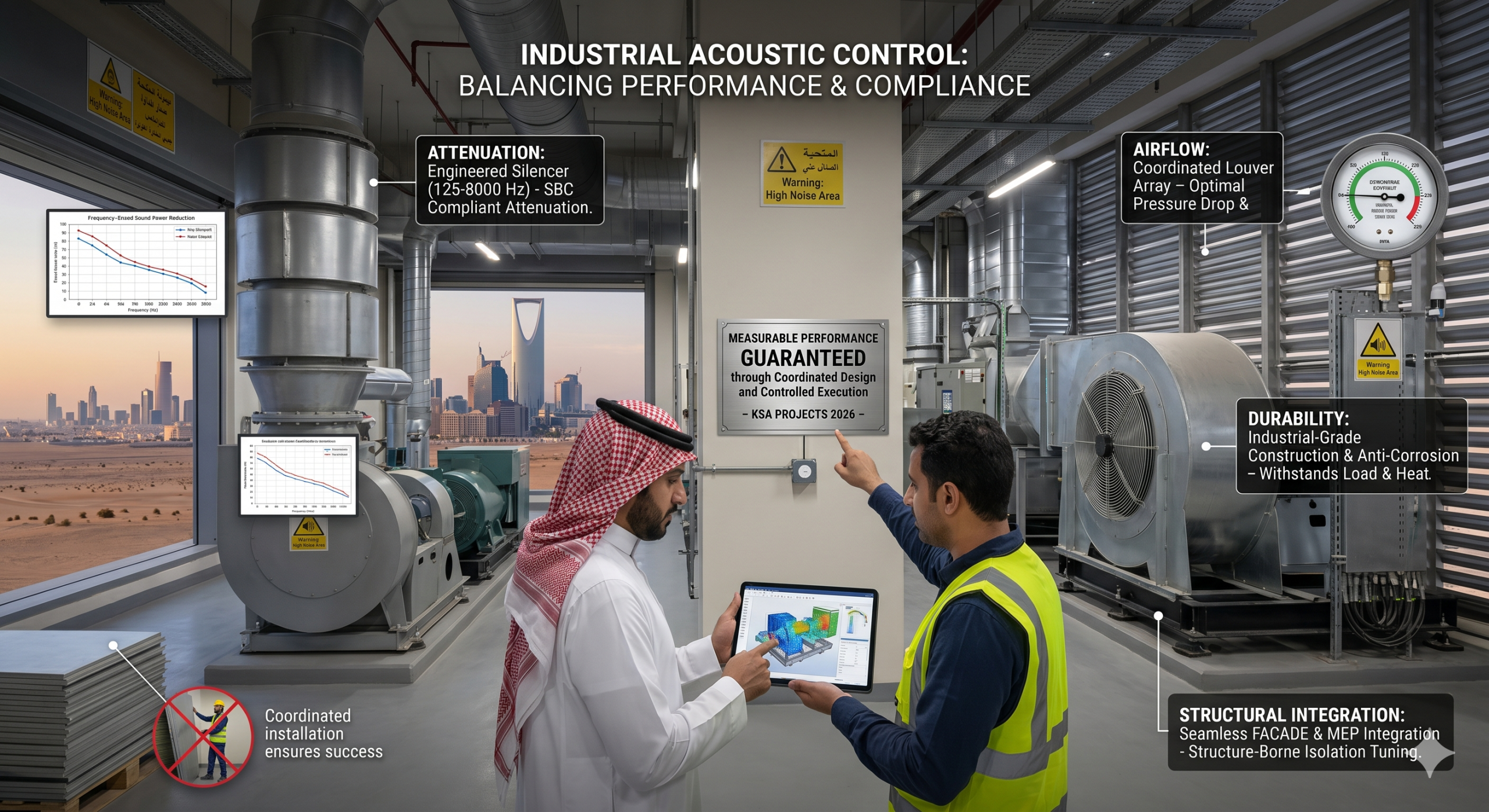
Industrial acoustic control must balance:
Attenuation
Airflow
Durability
Structural integration
Material supply without engineered installation leads to failure.
Coordinated design and controlled execution ensure measurable performance in Saudi projects.